
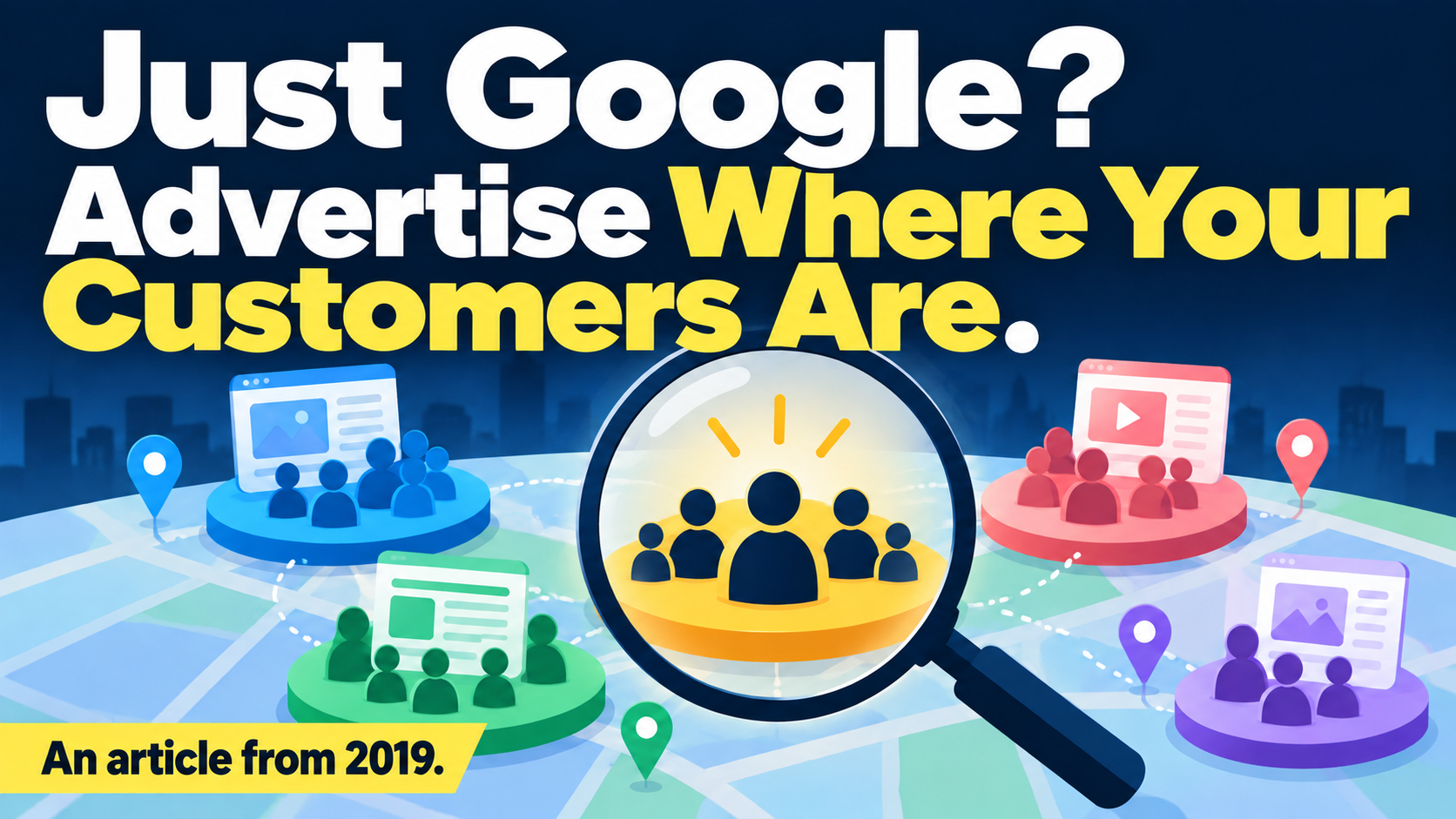
[Common Question] Should You Focus Web Ads on Google? Should You Also Run Them on Yahoo!? [Media Potential and Intensifying Competition]
From ACIDHOUSE, INC., this is Tetsuya Ashida.
I sometimes get questions like this from small business owners who have websites.

But I don't really know which to run them on. Should I focus on Google Ads? Or should I also do Yahoo! ads?
This article answers that kind of question.
Always have multiple ad media
 This applies not only to web ads but to customer acquisition methods in general: you should always secure multiple media.
It would be more accurate to say that what matters is the mindset of not depending on a single ad medium.
That's because of the following factors:
- The ad medium's rules
- The ad medium's performance
Let's look at each in detail.
The ad medium's rules
For example, the rules for placing Google Ads are, naturally, decided by Google.
Advertisers (account holders) are made to agree to Google's terms when they open an account, so if you violate the terms, your account may be frozen, or in the worst case suspended.
That means it is entirely possible that one day, out of the blue, the route through which new customers flow in gets cut off completely.
Those who have worked on SEO in the past may find this easy to imagine.
It's similar to an algorithm change dropping your search ranking so that traffic suddenly disappears.
- The side receiving the money has more power than the side paying it
- So depending on a single inflow route is absolutely a no-go
Keep these in mind.
The ad medium's performance
 An ad medium's performance is greatly influenced by two elements: "the potential of the ad medium itself" and "intensifying competition".
The potential of the ad medium itself
For ads to perform, many prospects must be viewing that medium frequently.
For advertisers, a medium is worth investing in precisely because prospects view it frequently; conversely, if few prospects view it, it isn't worth investing in.
Imagine fishing.
Is a fishing pond worth paying for if there are hardly any fish to catch?
Conversely, if you can expect to catch many fish, or there's a chance of catching a big one, don't you think it's worth investing in even if the pond's fee is fairly high?
That's what the potential of the ad medium itself means.
Intensifying competition
When competitors enter, ad costs soar and prospects' responses decline.
Continuing from before, let's use fishing as an analogy again.
If you have a pond with many fish and big fish all to yourself, you'll get a bite every time as long as you have decent bait.
But as more anglers show up—one, two, three...—naturally they start competing for the fish.
And as the number of anglers grows, the pond starts treating its customers, the anglers, differently.

In exchange... you'll make it worth my while, won't you??
It's a business, so of course.
Then this kind of angler appears:

Next, let's put ourselves in the fish's shoes.
The bait that was dangling until yesterday changes from discount-supermarket level to luxury-supermarket level.
Also, the timing and tricks of dangling bait diversify, and the fish that bite start to learn.
This is the decline in prospects' responses.
In a business that has matured to some extent, this almost always happens.
And this "fierce battle between ponds and anglers" is the reality of advertising and customer acquisition.
Which media should you advertise on?
Thinking about it that way, you'll understand that the micro-level question of whether to focus on Google Ads or also run Yahoo! ads isn't a wise approach in general.
To review once more, choose the ad media worth advertising on for your company based on these two viewpoints:
- The potential of the ad medium itself (whether it's a pond you should enter)
- The performance of the ad medium (whether the pond's entry fee is too high, whether the battle with competitors is fierce, whether the fish's responses are declining)
Use these as your criteria.
Which ad media have high potential as of 2019?
 Personally, I think it's these three:
- Video ads (especially YouTube ads)
- Instagram ads
- Facebook ads
From now on, it's overwhelmingly video.
Also, although they aren't as lucrative as before, Facebook ads and Instagram ads are still ad media you can run cost-effectively.
I didn't touch on it so far, but media have strengths and weaknesses depending on which target groups are heavily present, so please take that into account when prioritizing which media to advertise on.
*For example, Instagram ads reach many women, mainly in their twenties, so if you run a business in beauty, dieting, fashion, or the like, they are a very good fit.
In the end, advertising is a contest of funds
I wrote about ad potential, but considering that things eventually mature and competition intensifies, it becomes a contest of funds — the fate of capitalism.
It's an inconvenient truth, but for small businesses, fighting large corporations with huge capital on the same field is a losing battle.
That's why the speed of entry matters more than anything.
Assuming you've cleared the speed-of-entry hurdle, there is a way of running ads that lets even small businesses without abundant ad budgets win for sure.
That is...
This is one of the tactics of DRM (direct response marketing), an essential strategy for small businesses, and it is, so to speak, compound-interest investing in advertising. The more time passes, the further ahead of competitors you can pull.
For that purpose too, think of your ad budget as your army's provisions, and be sure to secure not a small amount but a budget of reasonable volume.
[The Essentials] The One Method to Master for Acquiring New Customers [Still the Answer in 2019] February 17, 2019