
[Personas] What Time Should You Set Your Newsletter to Send? [There's No Right Answer]
From ACIDHOUSE, INC., this is Tetsuya Ashida.
I sometimes get questions like this from small business owners who have websites.

There seem to be various theories — morning is good, noon is good, evening is good — so which is actually right?
This time I'll answer this question.
There's no absolutely right time
 When I answer this way, the person who asked reacts with "That doesn't satisfy me...", but I don't think I'm off the mark.
By the way, it's obvious that emails don't get read once time has passed since they were sent; the reason is the newest messages come to the top of the mailbox, and people check from the top.
And since this is an age of information overload, people don't go back that far, so it's perfectly normal for unopened emails sent long ago to lurk in the mailbox.
Have you properly clarified your persona?
 In the first place, thinking "What time is best to send emails?" is proof that you haven't clarified your persona.
In other words, it's about when the target customer has enough room to think "Well, I'll take a quick look" even at an email they're not very interested in.
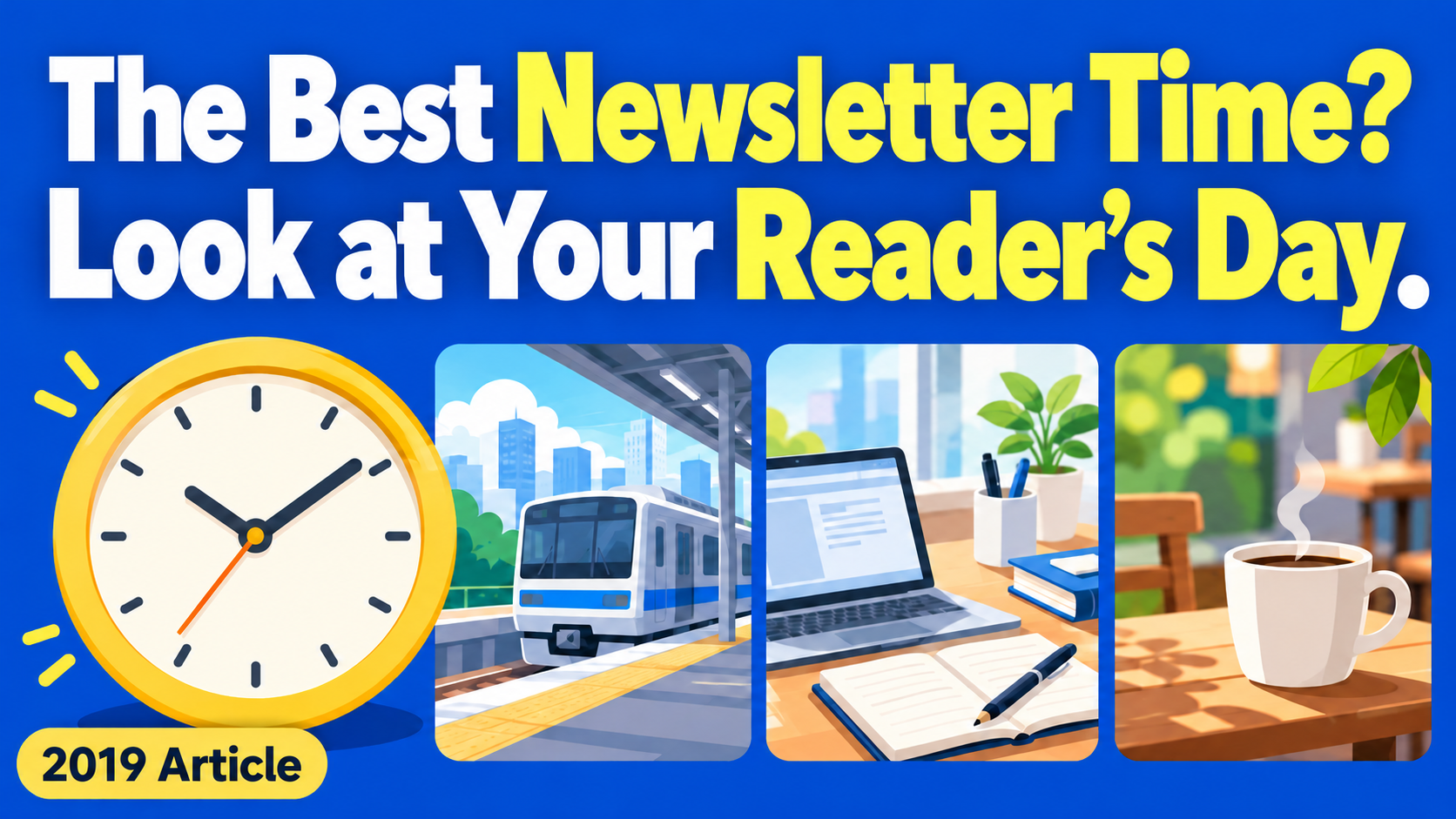
For example, if you're targeting salaried workers in their thirties in a B2C business:
- Time on the commuter train (around 7:00–9:00)
- Lunch break (around 12:00–14:00)
- Commute home (around 18:00–20:00)
Those are the windows.
That's because B2C emails now normally arrive on smartphones, and outside the times above, few people can look at their smartphones because they're at work.
However, it's different for the same salaried workers in their thirties in a B2B business. In B2B, people often register with their company email address, so you time your emails to be seen during working hours.
Also, many salaried workers in B2B businesses have a routine of checking email after arriving at the office, so morning (around 8:00–10:00) is thought to be especially effective.
Send time isn't the only thing that raises response
 However, the above applies when the target customer perceives the sender as "just an email from some vendor."
In fact, you can also do branding with a newsletter: by deepening your relationship with target customers day by day, you can flip things around so that they come to know when your emails arrive.
In this case, naturally, the open rate becomes very high.
I won't write the concrete steps in detail this time, but it's the same as measures using blog posts, YouTube videos, and newsletters.
The point is to keep steadily delivering valuable content. What proves powerful there is "step emails."
Of course, it's fine to combine the newsletter with other media too.
A newsletter isn't a sales catalog
 Many small businesses blast out newsletters as if to push products and services on people.
But I think you should suspect that this is a cause of lower open rates.
If you put yourself in the customer's shoes, you'll understand: most people don't like being sold to.
That's because what customers want to know is "whether it can solve my problem," and what they want isn't the product or service but the "result (benefit)".
When you earn customers' trust and make them believe they can get the result (benefit), customers will come seeking your products and services themselves.
The essence may be that the open rate is an expression of "customers'" expectations.
Toward the end I drifted from the main topic, but please use this as a reference.