
[For Beginners] What Is the Secret to Web Writing That Doesn't Fail?
Running our website, we've had more and more occasions where we need to write text.
But I'm not sure we're getting a response from customers. I feel the need to learn how to write in order to sell, but what should I do?
This article should help anyone with that question.
The biggest goal is "moving people"
When you're typing in front of a PC, "writing" tends to become the goal, but the real goal is this.
In other words, what you pursue is not "the technique of writing text" but "how to use the right words to make customers take action".
To go further, advertising was once described as "salesmanship in print."
Following that, you could call a website "a salesperson on a screen."
You have a high-performing salesperson work for you on the internet 24 hours a day, 365 days a year.
In life, the most important of all the abilities a person has is the ability to communicate their will. Gaining limitless wealth and success is easy. It is a matter of using the "right words" revealed in this book. These words work like magic!
Ted Nicholas, "Ted Nicholas's Complete Laws of Response Advertising Success"
The fact that, as of 2019, video content is taking priority over text also shows that what's needed is not "the skill of writing" but "the skill of using the right words."
That said, preparing a script is also important for speaking, so I think it's good to think of it as aiming to master "the skill of using the right words" while also improving your writing skills.
A common mistake: writing from scratch
If you treat writing as a chore, you tend to fall into this.
Just as any business learns from "case studies," it's better to incorporate "what has worked."
That's because great predecessors have already gone through repeated trial and error on "how to use the right words to make customers take action." The patterns for success are already in view.
That's why the world has "templates" and "swipe files".
Obtaining them can take effort or money, but since they shorten the time and effort of trial and error, they are highly cost-effective. Get proven "templates" and "swipe files."
Not learning history is a waste of time. Because you have to reinvent, pointlessly, what has already been "invented."
Dan Kennedy
You can collect swipe files by keeping ones that were effective or by buying them.
In this article, I'd like you to take away the point of avoiding the mistake of "writing from scratch."
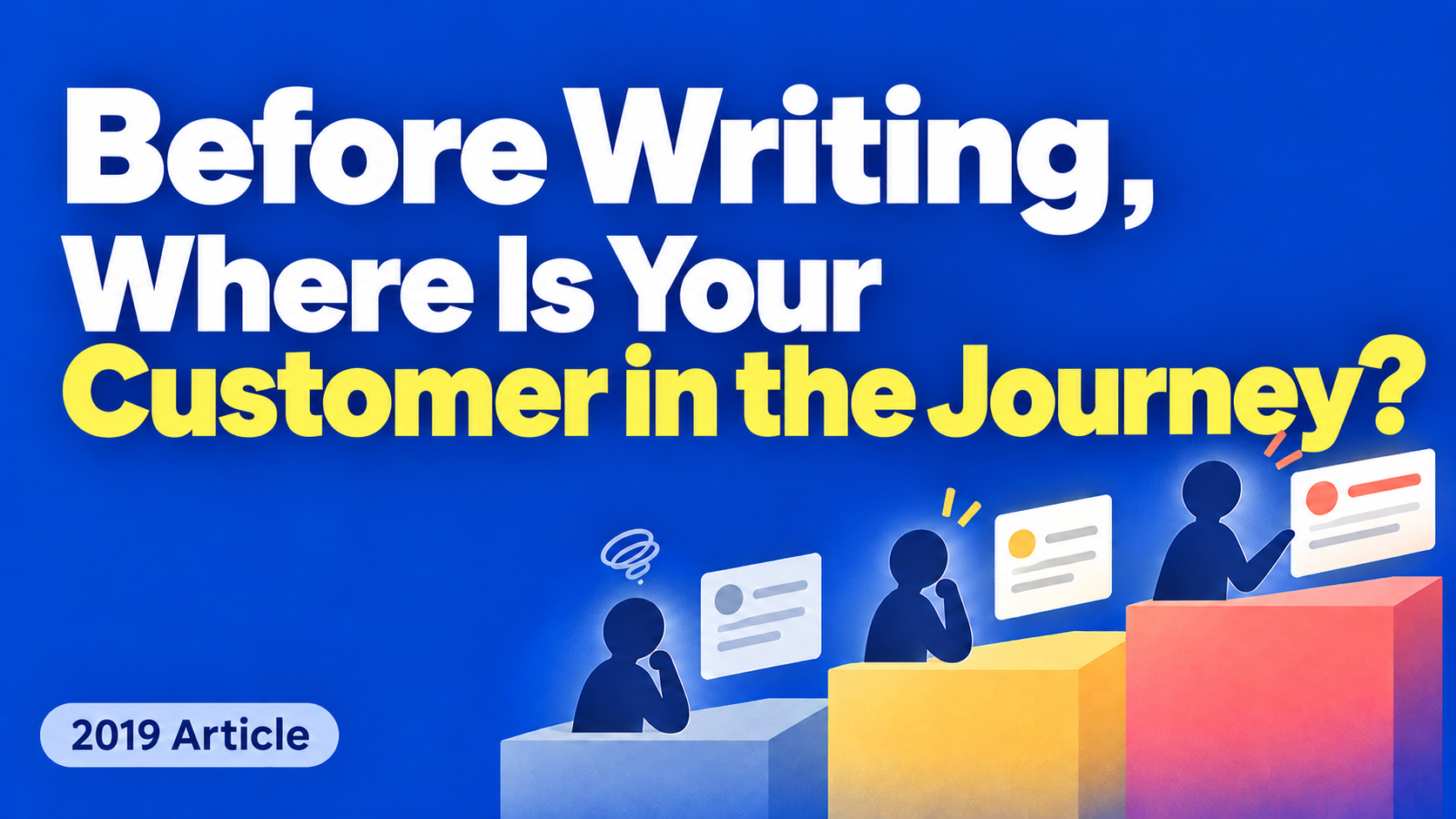
Who you're writing for (change what and where you write depending on the customer)
This is very important.
- Worried customers (low likelihood)
- Someday customers (low likelihood)
- Buy-now customers (high likelihood)
Most small businesses don't suddenly gain customers' trust and support, either for their products and services or as a company. Instead, customers step up from 1 to 3.
Let's look at them in detail.
Worried customers (low likelihood)
This is the state where they neither trust nor know your company or service.
However, explaining your company or service here, let alone pitching, is forbidden. That's because the customer's thinking stays within the scope of what to do about their worry.
Increasing trust and awareness = providing information × frequency
In other words, it's all about "give, give, give."
The media to use are owned media, YouTube channels, and so on, and I think "know-how" and "frequently asked questions and answers" are good.
Someday customers (low likelihood)
This is the state where the worried customers above want to remove their anxieties before taking action such as buying or inquiring.
You still mustn't pitch at this stage, but the intention to take action is emerging, so information that removes anxieties is welcomed.
Rather than providing information, it's closer to the image of "navigating which option the customer should take to truly solve their worry".
So things like differences from competitors, the best plan, and giving samples are welcomed.
The media to use are email newsletters, service pages, LPs (landing pages) and the like. Embedding YouTube in your LP is good too.
Buy-now customers (high likelihood)
This is the state where the someday customer's trust has turned considerably toward your product or service. Only now, finally, can you make a sale.
This is like a final interview in hiring: a message focused on confirming whether you can truly be trusted.
Besides service pages and LPs (landing pages), live videos on YouTube and Facebook are also powerful media here.
How do you acquire it as a skill?
It overlaps with the "salesperson" analogy, but honestly, "you get better through practice."
However, as the phrase "shu-ha-ri" (learn the form, break the form, leave the form) suggests, there are tools that greatly help your practice.
- Technical books on copywriting
- Swipe files
Copywriting isn't that familiar in Japan, but in America, the front line of sales and marketing, it has a history of over 100 years.
There are also many cases where a single sales letter generated sales in the hundreds of millions of yen.
In other words, mastering copywriting techniques is precisely "how to use the right words to make customers take action".
Also, by hand-copying swipe files (copying them word for word into a notebook by hand), you can let them soak into your body (your subconscious) as a skill.
I've listed my recommendations below, so if you're interested, please check them out.