
3 Things Companies Should Change to Survive From 2020 Onward
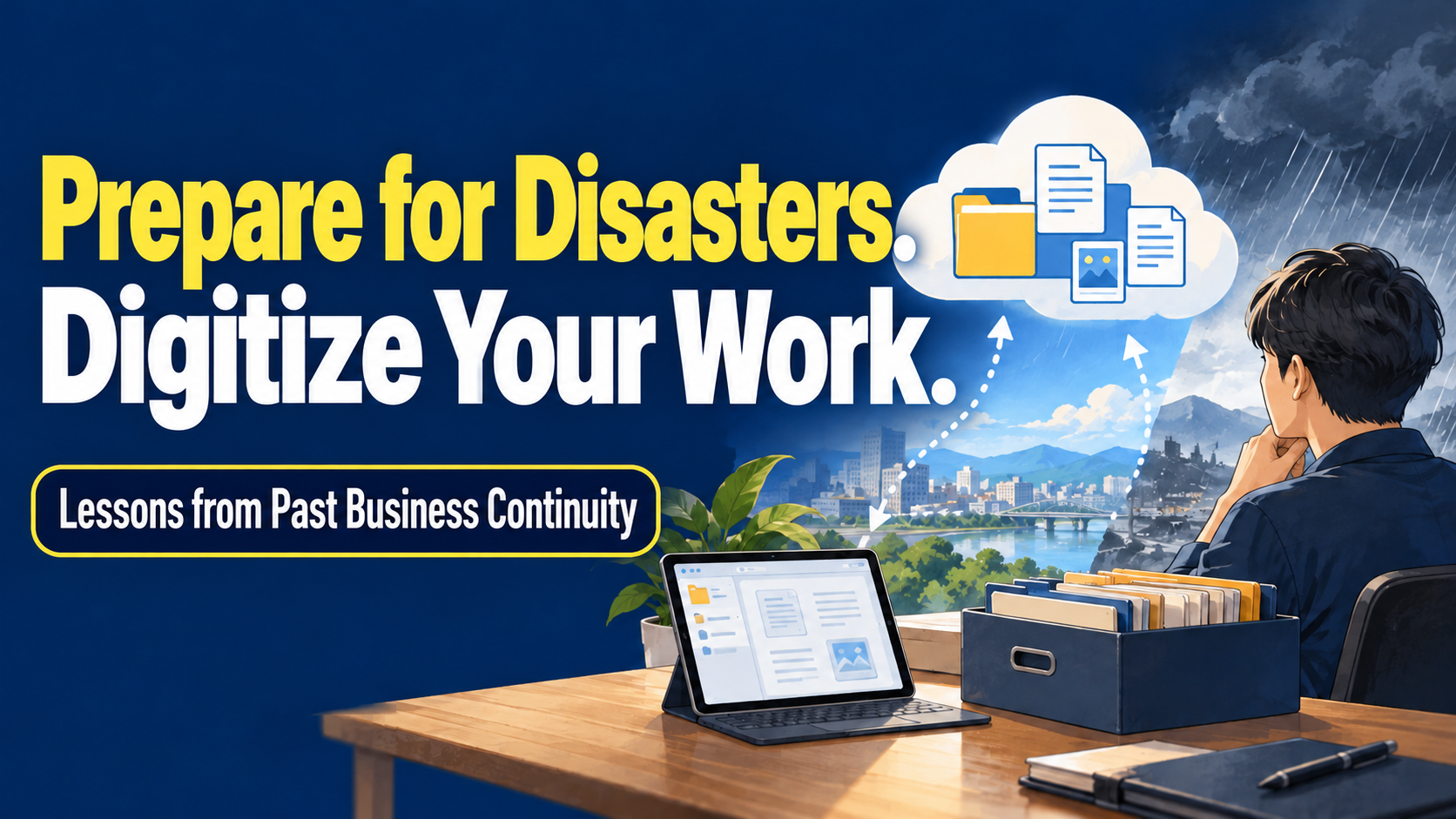
Natural disasters really do hit us a lot these days.
It would be nice if nothing happened, but some companies and households have surely been damaged. Recovering can't be easy.
And the troublesome part is that we can't rest easy thinking, "A disaster this large won't happen again any time soon."
So what should we prepare in ordinary times to minimize the damage from disasters yet to come?
That is the topic I want to take up this time.
Check the content in text
To give the conclusion first, I think the best approach is to "cut out the analog and pursue cost-effectiveness."
Thoroughly eliminate the analog
Do you know what a nomad worker is?
To put it in extreme terms, it is a freelancer who works with a work style (lifestyle) that lets them work anywhere in the world as long as they have a mobile device (laptop, iPad, etc.) and Wi-Fi.
When I put it that way, some of you may think, "We're not in IT, so that doesn't apply to us!" But that is not my point.
What matters is "keeping the infrastructure your business needs minimal and highly mobile."
And this directly affects how quickly you can recover.
Rather than doing desk work buried in mountains of paperwork, don't you think that with a mobile device, Wi-Fi, and the cloud you can do highly mobile work on minimal infrastructure?
Put truly important documents in a safe-deposit box
Some of you may say, "Even so, paper is important!"
In that case, ask yourself, "How many truly important documents are there?" and "What kind of storage is actually useful?"
Most documents and notes don't need to be kept forever, so you should be able to "scan them or take a photo with your phone once you've finished writing" and send them to the shredder.
Data at that level is better created on a PC or tablet from the start.
I believe official documents of the highest importance and documents entrusted to you by employees should be kept in a safe-deposit box rather than in the office.
Also, seals (hanko) and contracts can be replaced with services such as "CloudSign," so rather than continuing to use seals and documents that are troublesome and time-consuming to manage, it is safer and more efficient to move to digital as much as possible.
It is also a good idea to create a digital archive so that you can refer to the data you have stored in the safe-deposit box.
Switch from a PC to an iPad (tablet)
Unless you work in a creative role, you don't need a PC whose selling point is high specs.
For most desk jobs, a tablet (iPad) is more than enough.
The screen is large, you can attach a keyboard, and you can use a pencil like a handwritten notebook. And it is light.
The handwritten-notebook function can replace a whiteboard if you project it onto the meeting room monitor, and you can also share your screen in online meetings.
*There are many other advantages to using an iPad rather than a PC for work, so please refer to the following article.
PCs Are Over. Small Businesses Should Shift to the iPad Right Away and Boost Productivity! October 23, 2019
Review whether ISMS or the Privacy Mark is holding your business back
More than ten years ago, when the use of technology and the internet in business took off in earnest, a series of personal data leaks led more companies to comply with the Act on the Protection of Personal Information and obtain certifications proving it.
But now we are in an era where the use of the cloud and big data raises companies' mobility and plays a major role in their growth.
ISMS and the Privacy Mark are merely one proof of trustworthiness — "we take care with information management" — and they do not directly lead to profit.
On the other hand, obtaining these certifications greatly restricts how work is done, and you may become unable to enjoy the benefits of using the cloud and big data.
Losing operational mobility because you hold ISMS or the Privacy Mark is putting the cart before the horse.
Let's carefully examine whether information management regulations are lowering your business's productivity, or whether they require unnecessary investment and have become a burden.
Summary
- Thoroughly eliminate the analog
- Put truly important documents in a safe-deposit box
- Review whether ISMS or the Privacy Mark is holding your business back
Beyond these points, there are probably many opportunities to improve productivity by discarding past customs and tasks you have done as a matter of course.